
Product notes ·
Every finding needs a source
Making an agent’s observations possible to check.
A fluent summary is not enough
An agent can produce a clear-sounding review while leaving the reader unable to verify it. For a product built around personal trade records, that is a practical problem. The reader needs to know which note supports an observation and whether the original wording says what the summary suggests.
Keep the evidence close
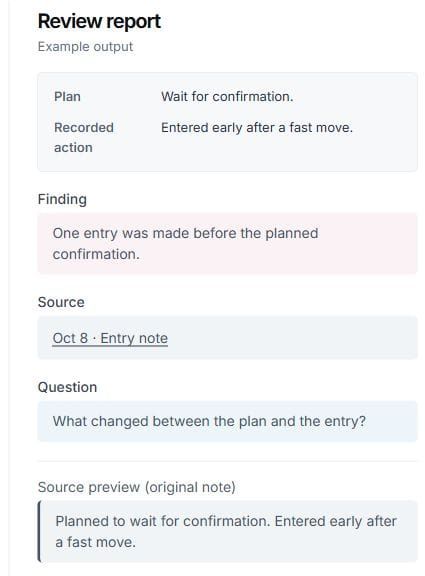
In ThinkerGain’s concept, a finding sits beside a link to its source record. Opening the link reveals the original note, so the reader can inspect it without losing the review context. The source should support the specific observation, not simply be a related document.
Separate observation from interpretation
“The note says the entry was early” is different from “the trader was impatient.” The first can be checked against a record; the second is an interpretation that may need more context. A source link does not remove the need for judgment. It makes the boundary between evidence and interpretation easier to see.
What we want to test
As development progresses, we want to evaluate whether observations stay within what the records support, whether source links point to the right notes, and whether a reader can understand the comparison. These are product design goals, not claims of completed validation. We will document what we learn here and share product updates through the free subscription.
Check the sentence against the note
In the sample record, the note reads: “Planned to wait for confirmation. Entered early after a fast move.” A supported observation is that the entry preceded the planned confirmation. The note does not establish the trader’s emotional state, how large the position was, or what would have happened if they had waited.
When opening a source, check three things: whether it is the right trade, whether the quoted wording is accurate, and whether the finding stays within that wording. If the source is incomplete or two notes conflict, the review should expose the gap and leave a question. A source link is useful only when the reader can use it to check the actual claim.